The Dentist Who Started Two Companies
Every company has an origin story it polishes for the website. Ours resists polishing, because it begins with a dental emergency.
The broken tooth
In 2013 and 2014, my co-founder Gustavo and I were running out of money. We were on our second startup in a row that wasn’t working - first an “Airbnb for cars,” then a ride-sharing project that went viral on national TV and never made a real. The money was nearly gone. The situation had collapsed into a binary: build something that earns revenue, or go find jobs.
I grind my teeth when I’m nervous. That year, I had a lot to be nervous about - enough that the bruxism finally broke one of my teeth, and I had to go to my dentist to fix it.
While I was in her chair, I learned that the software running her practice had just failed her. Again. And when I looked at it, I understood why: it ran on a Windows virtual machine, on the Mac at her reception desk, connected to a physical server sitting inside the office. Every layer of that stack was an accident waiting to happen, and the accidents kept arriving on schedule. I tried to fix the immediate problem for her. I couldn’t.
So I asked the only question that mattered: “What do you pay for this?”
A thousand reais a year.
One day to a mockup, one month to a product
I went home with an idea I couldn’t put down: build the thing she actually needed. That same night, I made a mockup of it. Not a spec, not a business plan - screens. I showed them to Gustavo, and we did what we’d keep doing for the next decade: we cut. Simplified everything down to the smallest product that would genuinely serve her.
The next day, I had lunch with my dentist and put the mockup in front of her.
“Would you pay for this? It’ll cost a thousand a year - what you pay today.”
Her answer was a loud, instant “CLARO!” - of course. I confess I didn’t believe it. People are polite at lunch. So I spent the rest of the week showing those mockups to every dentist I could reach, asking the same blunt question about the same price. The answers kept coming back yes - yes to the need, yes to the willingness to pay.
There is one upside to having a rope around your neck: development flies. With no revenue and no time, there’s no temptation to gold-plate. Exactly one month after that lunch, the first version of Doutore was live in her clinic - a dead-simple daily agenda and a patient history we called Histórico. She was our first paying customer.
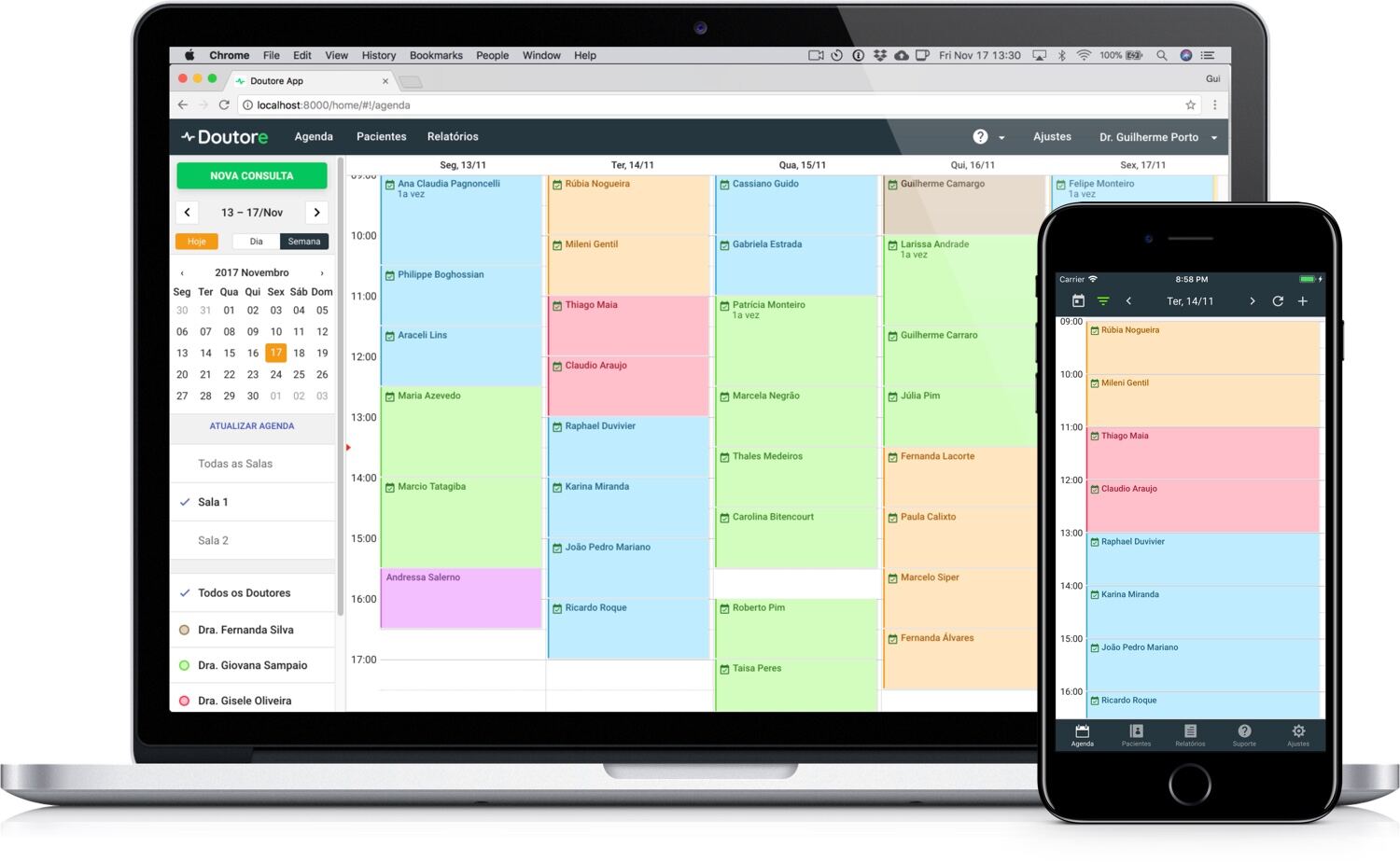
That was 2014. We’ve been profitable since the following year and never raised a cent.
Eleven years later
She’s still a customer today. She knows she’s customer #1 - it’s not a secret between us; it’s a small shared piece of history. Over the years she became something more useful than a customer: one of our best advisors. When you’ve served someone for eleven years, watched their practice change, fixed what broke and built what was missing, the relationship stops being commercial. She tells us the truth.
And that’s how the same office produced a second company.
The intern
Years later - eleven years into running a profitable software business - we could see another problem clearly. In Brazilian healthcare, getting documents legally signed is painful. The standard approach demands an ICP-Brasil digital certificate that most patients simply don’t have. Consent forms, contracts, treatment plans: every clinic improvises around the same broken process.
We knew the problem was real. But for us, knowing has never been the bar. Understanding is.
So I went back to my dentist with a strange request: I asked her to let me work at her front desk. As an intern. I sat where her secretary sits, and I handled the paperwork myself - contract by contract, signature by signature, patient by patient. I felt exactly where the process stalls, what patients don’t understand, what the front desk improvises to get a signature collected before the next appointment walks in.
SantoDoc - our e-signature product, legally valid without the certificate - came out of that chair. Built for her first. Then for everyone.
What this story is actually about
It would be tidy to say the lesson is “solve a real problem for a real person.” That’s true and useless - everyone says it.
The real lesson is narrower and harder: proximity is a method, not a phase. The dentist’s chair gave us our first product because I happened to be sitting in it. The front desk gave us our second product because I chose to sit at it, a decade later, when nothing forced me to. The accident became a discipline.
Some companies start with a pitch deck. Ours started with a broken tooth - and we’ve been going back to that office ever since.
Registro encerrado · 10.06.2026